The idea of time illusion comes from both philosophical arguments and interpretations of modern physics, particularly Relativity and Quantum Mechanics.
The illusion is not that time doesn't exist at all, but that our perception of a unidirectional "flow" from the past to the future may be a construct of our minds or an emergent property rather than a fundamental characteristic of the universe.
Einstein's Theory of Relativity: Einstein's theories treat time and space as a unified, four-dimensional structure called spacetime.
In this view, known as the Block Universe theory, all events—past, present, and future—are equally real and exist simultaneously, much like all points on a map.
Time is relative, meaning its rate depends on an observer's speed and proximity to gravity.
This challenges the notion of a universal, flowing "now."
Quantum Mechanics and Emergence: Some interpretations of quantum mechanics, like the Page and Wootters mechanism, suggest that at the fundamental quantum level, the universe is static and timeless.
Our perception of time emerges from the entanglement and correlations between quantum systems, where one system acts as a "clock" relative to another.
Thermodynamics and Entropy: The one clear direction in time, often called the Arrow of Time, is linked to the Second Law of Thermodynamics and the increase of entropy (disorder) in a closed system.
Objects naturally cool down, and messes naturally increase—this irreversible process provides a direction for time, which some physicists suggest is the basis for our psychological experience of time flowing forward.
🌊 Wave and Particle: Duality
The concept of wave-particle duality is a foundational pillar of quantum mechanics that resolves the historical debate about the nature of light and matter.
The Concept: Wave-particle duality states that every quantum entity—such as photons (packets of light energy) and electrons (particles of matter)—exhibits the properties of both waves and particles.
Particle Properties: As a particle, an entity is a discrete, localized packet of energy or matter that can be counted and has specific properties like mass and momentum.
In an experiment, particles arrive at a detector at a single, distinct point.
Wave Properties: As a wave, an entity is spread out in space and is characterized by properties like wavelength and frequency. Waves can exhibit diffraction (bending around obstacles) and interference (combining to create new patterns).
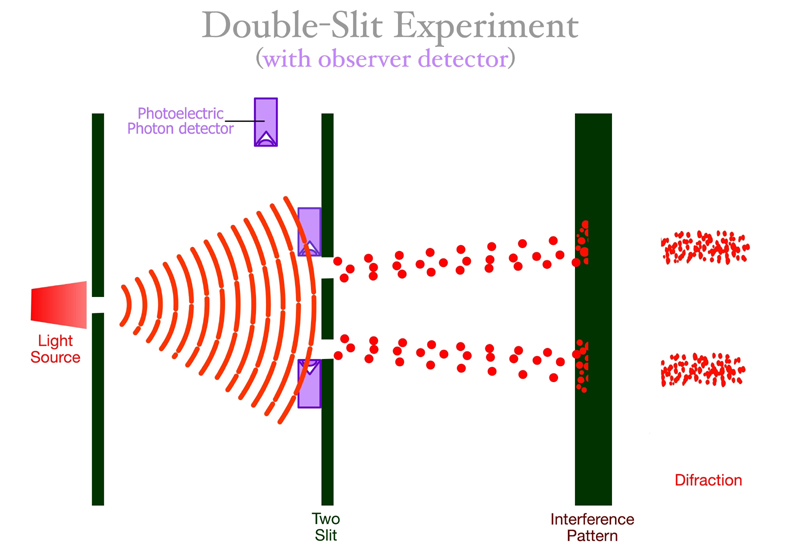
The Double-Slit Experiment: This classic experiment is the most powerful demonstration of duality. When particles like electrons are fired at a barrier with two slits:
If no one observes them, they create an interference pattern (a wave property) on the screen behind the barrier.
If detectors are placed at the slits to determine which slit the particle goes through, the wave function "collapses," and they behave like classical particles, creating a pattern of two distinct lines (a particle property).
Wave and particle behaviours are complementary; they cannot be observed simultaneously in the same experiment, but both are necessary for a complete description of the quantum entity.
The video below explains the radical idea that time might not be a fundamental property of the universe but an emergent phenomenon.